 Deutsch


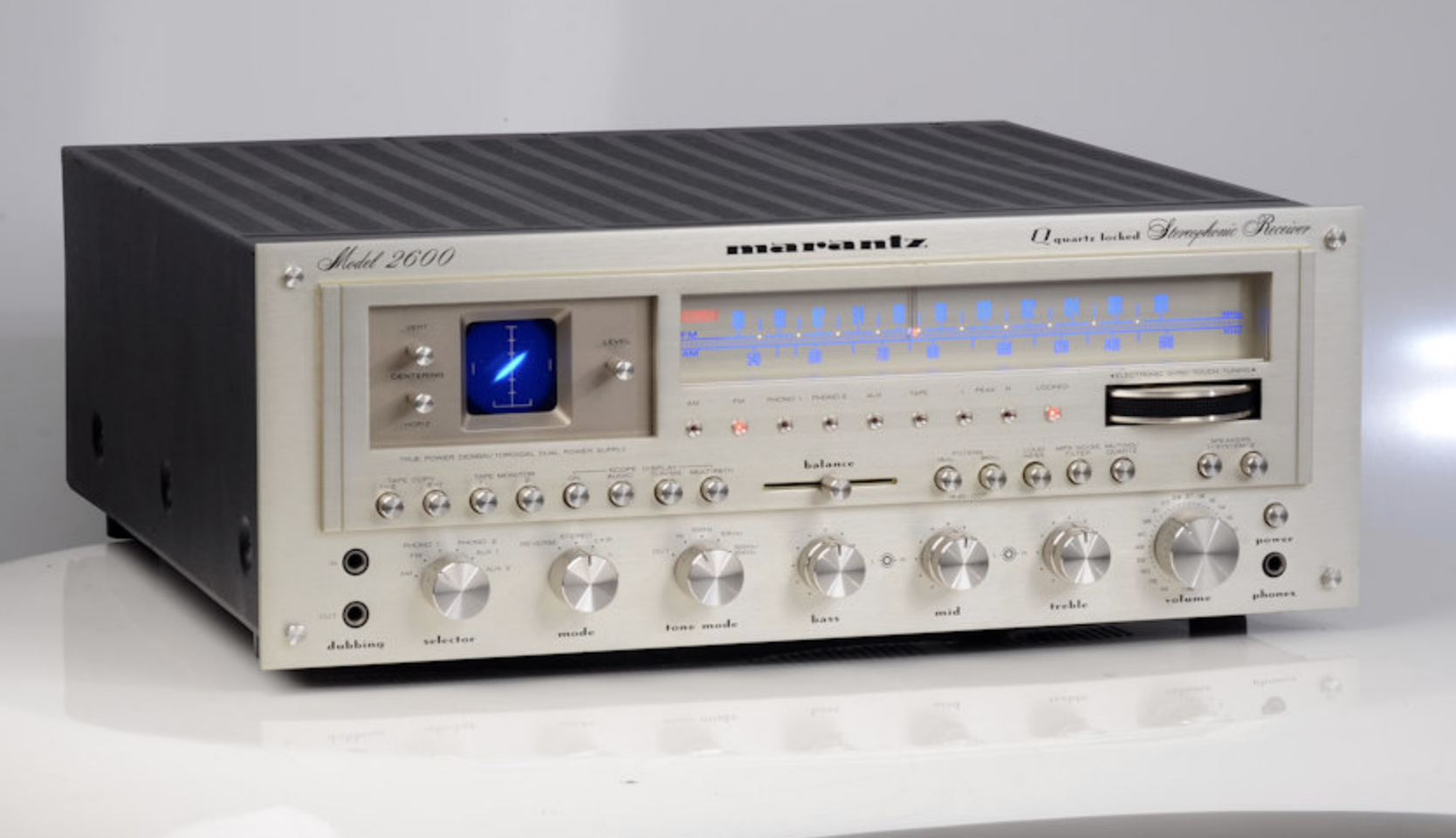
Marantz 2600
The
Marantz 2600, produced between 1978 and 1980, is widely regarded as one of the most powerful "monster receivers" ever built. It is famous for its immense power output and its built-in oscilloscope for visual signal monitoring.
Core Performance Specifications
The Marantz 2600 was engineered for extreme power with high fidelity.
- Power Output (8Ω): 300 Watts RMS per channel into 8 ohms, with no more than 0.03% total harmonic distortion (THD).
- Power Output (4Ω): 400 Watts RMS per channel into 4 ohms, with 0.05% THD.
- Frequency Response: 20 Hz to 20 kHz (+/- 0.2 dB).
- Power Bandwidth: 20 Hz to 20 kHz.
- Intermodulation Distortion: 0.03% at 8 ohms.
Key Features
- Oscilloscope (Vectorscope): A built-in CRT display on the front panel that visualizes musical signals and assists in precise FM tuning.
- Cooling System: Features a specialized "tunnel ram" cooling system and a built-in fan to manage the significant heat generated by its high power output.
- Internal Components: The unit is built with a dual mono power transformer and power supply to maximize channel separation and audio quality. It contains 12 FETs, 11 ICs, 130 transistors, and 84 diodes.
- Phono Stage: Includes an integrated Moving Magnet (MM) phono stage with a dynamic range of 113 dB and a signal-to-noise ratio of 98 dB.
Physical Specifications
Due to its massive build, this receiver requires substantial space and a sturdy support surface.
- Dimensions: Approximately 49.1 cm x 17.8 cm x 43.5 cm (19 ¼" x 7" x 17 ⅛").
- Weight: 27.4 kg (60.3 lbs).
- Power Consumption: Consumes 920 watts at its rated power output.

Add your review